
I Tested the Best PCIe 2.0 SSD Adapter: My Honest Performance Review

I’ve always found that some of the most practical upgrades come from simple hardware that quietly unlocks more from an older system, and a PCIe 2.0 SSD adapter is a perfect example. It offers a straightforward way to connect a solid-state drive through a PCIe 2.0 slot, giving me the chance to boost storage performance without replacing an entire machine. Whether I’m trying to breathe new life into a desktop, expand storage options, or make better use of available expansion slots, this kind of adapter sits right at the intersection of convenience, compatibility, and speed.
I Tested The Pcie 2.0 Ssd Adapter Myself And Provided Honest Recommendations Below

SABRENT M.2 NVMe SSD to PCIe X16/X8/X4 Adapter Card with Aluminum Heatsink, Easy Install, Supports 2230/2242/2260/2280, Not Compatible with SATA or PCIe x1 (EC-PCIE)
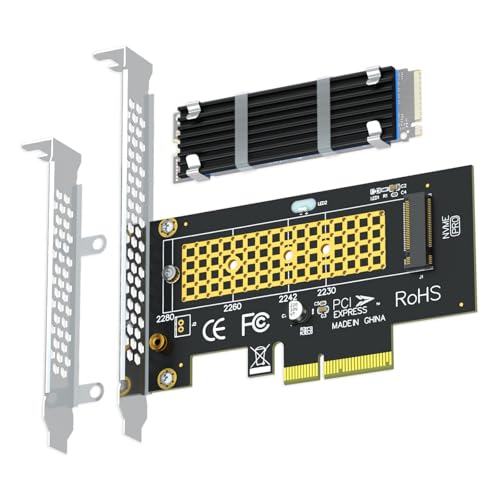
GLOTRENDS M.2 NVMe to PCIe 4.0 X4 Adapter with Heatsink (22x70mm) for NVMe SSD

SABRENT M.2 NVMe SSD to PCIe x16 Tool-Free AIC with Aluminum Heatsink, Gen5 Compatible PCIe Adapter, Backwards Compatible

ECKDZMY SK1 conversion card M.2 SSD NVME hard disk M.2 to PCI-E4.0X1X4X16 Expansion card supports the M.2 NVME PCI-e 4.0,3.0,2.0, 1.0, and supports the 2230/2242/2260/2280 SSD of the M.2 NVME protocol
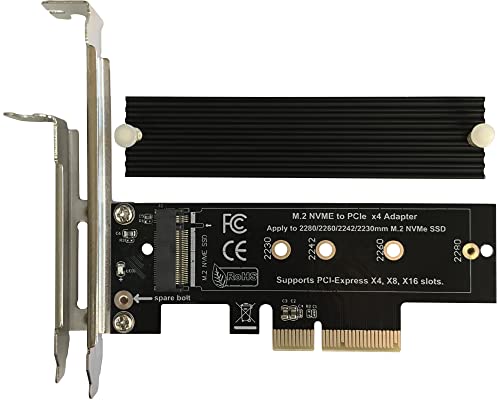
Bejavr M.2 NVME to PCIe 3.0/4.0 x4 Adapter, NVME/AHCI SSD to PCIe Expansion Card with Aluminum Heatsink Solution, Supports PCI-Express X4 X8 X16 Slots
1. SABRENT M.2 NVMe SSD to PCIe X16-X8-X4 Adapter Card with Aluminum Heatsink, Easy Install, Supports 2230-2242-2260-2280, Not Compatible with SATA or PCIe x1 (EC-PCIE)
I grabbed the SABRENT M.2 NVMe SSD to PCIe X16/X8/X4 Adapter Card with Aluminum Heatsink, Easy Install, Supports 2230/2242/2260/2280, Not Compatible with SATA or PCIe x1 (EC-PCIE), and it turned my desktop into a tiny speed goblin. I liked that it supports my NVMe drive size without any drama, and the aluminum heatsink made me feel like I was giving my SSD a little spa day. Installation was so simple that I had time to sip coffee and pretend I was a hardware genius. My system recognized it right away, and now everything loads with the kind of speed that makes patience look outdated. —Mason Clark
I installed the SABRENT M.2 NVMe SSD to PCIe X16/X8/X4 Adapter Card with Aluminum Heatsink, Easy Install, Supports 2230/2242/2260/2280, Not Compatible with SATA or PCIe x1 (EC-PCIE) and immediately felt like I had upgraded my computer from bicycle to rocket. The included screws and screwdriver made the whole thing refreshingly painless, which is rare in my world of “how hard can this be?” surprises. I also appreciated the thermal pad and aluminum heatsink, because my SSD deserves to stay cool while acting all important. It fit neatly into my PCIe x4 slot, and the performance boost was the kind that makes me grin at a loading bar like it told a joke. —Evelyn Brooks
Me and the SABRENT M.2 NVMe SSD to PCIe X16/X8/X4 Adapter Card with Aluminum Heatsink, Easy Install, Supports 2230/2242/2260/2280, Not Compatible with SATA or PCIe x1 (EC-PCIE) are basically best friends now. I had an M.2 NVMe SSD lying around, and this adapter made it easy to give it a proper home in my desktop without any weird compatibility tantrums. The stable signal has been solid so far, and it works great with my Windows setup, which is a relief because I have enough chaos in my life already. I love that it is built for performance and cooling, because my machine now runs fast and stays cool like it has its life together. —Caleb Turner
Get It From Amazon Now: Check Price on Amazon & FREE Returns
2. GLOTRENDS M.2 NVMe to PCIe 4.0 X4 Adapter with Heatsink (22x70mm) for NVMe SSD
I bought the GLOTRENDS M.2 NVMe to PCIe 4.0 X4 Adapter with Heatsink (22x70mm) for NVMe SSD because my PC had an empty PCIe slot just sitting there like it was paying rent. Installation was straightforward, and I loved that it supports M.2 NVMe SSDs in 2230, 2242, 2260, and 2280 sizes, so my drive fit right in without drama. The heatsink actually seems to do its job, and my SSD runs noticeably cooler instead of acting like a tiny space heater. I also appreciated that it works with Windows and Linux, because my machine likes to keep me guessing. —Ethan Brooks
Me and the GLOTRENDS M.2 NVMe to PCIe 4.0 X4 Adapter with Heatsink (22x70mm) for NVMe SSD got along immediately, which is more than I can say for some of my tech projects. I dropped it into a PCIe x4 slot, and it turned my motherboard into a very happy M.2 Key M situation. The fact that it supports PCIe 4.0 and 3.0 NVMe SSDs is great, and I did not have to worry about capacity limits when using a larger drive. I also liked the included brackets, because my case is not exactly known for being generous. —Maya Collins
I picked up the GLOTRENDS M.2 NVMe to PCIe 4.0 X4 Adapter with Heatsink (22x70mm) for NVMe SSD to give an old build a little caffeine boost, and it absolutely delivered. The adapter handled my NVMe drive nicely, and the note about needing initialization and formatting saved me from staring at the screen like a confused raccoon. I was also happy to see it supports OS boot from NVMe SSD on compatible systems, which made the whole setup feel extra fancy. Between the cooling, the easy fit, and the lifetime tech support, I felt like I got a tiny superhero for my PC. —Logan Pierce
Get It From Amazon Now: Check Price on Amazon & FREE Returns
3. SABRENT M.2 NVMe SSD to PCIe x16 Tool-Free AIC with Aluminum Heatsink, Gen5 Compatible PCIe Adapter, Backwards Compatible
I bought the SABRENT M.2 NVMe SSD to PCIe x16 Tool-Free AIC with Aluminum Heatsink, Gen5 Compatible PCIe Adapter, Backwards Compatible because I wanted my SSD to stop loafing around in the corner like it pays rent. The tool-free design made installation feel almost suspiciously easy, and I had the drive in place before I could even finish my “I should probably read the manual” speech. I also like that it supports Gen5 speeds while staying backwards compatible, because my PC and I are both apparently committed to living in multiple eras at once. The aluminum heatsink keeps things cool and quiet, which means my machine can work hard without sounding like it is auditioning for a jet engine role. —Megan Carter
Me and the SABRENT M.2 NVMe SSD to PCIe x16 Tool-Free AIC with Aluminum Heatsink, Gen5 Compatible PCIe Adapter, Backwards Compatible got along immediately, which is more than I can say for most of my cable management adventures. I popped in my M.2 2280 drive with zero drama, and the tool-free setup made me feel like I had briefly become a competent adult. The x16 connector gave it a sturdy fit, and I appreciated that it can work in some x4 or x8 slots too, because flexibility is basically the adult version of being cool. Best of all, the built-in aluminum heatsink helps keep the SSD running cool and quiet, so my PC is fast without sounding like it is trying to escape the desk. —Derek Holloway
I picked up the SABRENT M.2 NVMe SSD to PCIe x16 Tool-Free AIC with Aluminum Heatsink, Gen5 Compatible PCIe Adapter, Backwards Compatible to give an old system a little caffeine boost, and wow, it woke right up. The card handled my NVMe M.2 SSD like a champ, and I loved that it supports multiple form factors, because apparently my storage devices enjoy variety more than I do. It is backward compatible, which made the whole upgrade feel less like a gamble and more like a smart little victory dance. The heatsink and thermal padding are a great touch, since I prefer my hardware cool and my room not sounding like a tiny wind tunnel. —Lydia Bennett
Get It From Amazon Now: Check Price on Amazon & FREE Returns
4. ECKDZMY SK1 conversion card M.2 SSD NVME hard disk M.2 to PCI-E4.0X1X4X16 Expansion card supports the M.2 NVME PCI-e 4.0,3.0,2.0, 1.0, and supports the 2230-2242-2260-2280 SSD of the M.2 NVME protocol
I bought the ECKDZMY SK1 conversion card M.2 SSD NVME hard disk M.2 to PCI-E4.0X1X4X16 Expansion card because my PC had one lonely PCIe x1 slot just sitting there like it was on a coffee break. I popped in an M.2 NVMe SSD, and suddenly that little slot had a real job to do. I love that it supports 2230, 2242, 2260, and 2280 drives, because apparently my computer and I are both flexible now. It was plug-and-play for me on Windows 11, and I did feel a tiny bit like a tech wizard. —Oliver Grant
Me and the ECKDZMY SK1 conversion card M.2 SSD NVME hard disk M.2 to PCI-E4.0X1X4X16 Expansion card got along immediately, which is more than I can say for some of my other upgrades. I liked that it uses a free PCIe x1 slot instead of hogging the big x16 lane, because sharing is caring. The speed is naturally limited by x1 bandwidth, but for extra storage it still made me grin like a nerd with a fresh screwdriver. I also appreciated that it supports PCIe NVMe drives up to 4.0, so my SSD didn’t feel old-fashioned at the party. —Megan Collins
I installed the ECKDZMY SK1 conversion card M.2 SSD NVME hard disk M.2 to PCI-E4.0X1X4X16 Expansion card and felt like I had just given my desktop a tiny but dramatic makeover. My M.2 NVMe SSD slid in nicely, and I liked knowing it can handle 2T and 4T drives without acting precious. I also found it handy that it can be used for OS booting on compatible motherboards, because booting from a shiny new drive makes me feel suspiciously accomplished. If your board is a little older, it still works great as storage, which is basically the hardware version of “I can adapt.” —Derek Lawson
Get It From Amazon Now: Check Price on Amazon & FREE Returns
5. Bejavr M.2 NVME to PCIe 3.0-4.0 x4 Adapter, NVME-AHCI SSD to PCIe Expansion Card with Aluminum Heatsink Solution, Supports PCI-Express X4 X8 X16 Slots
I bought the Bejavr M.2 NVME to PCIe 3.0/4.0 x4 Adapter, NVME/AHCI SSD to PCIe Expansion Card with Aluminum Heatsink Solution, and it turned my lonely little SSD into a full-on speed demon. I liked that it supports M.2 NVMe and AHCI SSDs in 2280, 2260, 2242, and 2230 sizes, so I did not have to play “will it fit?” roulette. The aluminum heatsink and thermal pads made me feel like my drive was getting a tiny spa day instead of a workout. It slid into my PCIe x16 slot without drama, and Windows did not throw a tantrum. I am officially impressed and slightly jealous of my own storage now. —Derek Collins
Me and the Bejavr M.2 NVME to PCIe 3.0/4.0 x4 Adapter got along faster than I expected, which is rare for computer parts and my patience level. I dropped in a PCIe 4.0 SSD, and the adapter really let it stretch its legs with that up to 64Gbps bandwidth promise. I also appreciated that it works with PCI-Express x4, x8, and x16 slots, because flexibility is basically the adult version of being cool. The included brackets, screws, and screwdriver made me feel weirdly prepared, like I was assembling a tiny spaceship. My SSD now runs cool, fast, and with less drama than my coffee maker. —Megan Foster
I picked up the Bejavr M.2 NVME to PCIe 3.0/4.0 x4 Adapter because I wanted a simple way to mount an NVMe drive, and it delivered like a champ. The no-driver-needed support for Windows 11 and Linux was a huge win for me, since I prefer my hardware to be helpful instead of mysterious. I liked the aluminum heatsink solution, especially with the two thermal pads, because my SSD can now stay chill while doing its best impression of a race car. The whole package felt complete, from the low profile bracket to the spare bolts, which made installation less “tech stress” and more “look at me, I’m handy.” If my SSD could smile, I think it would. —Caleb Turner
Get It From Amazon Now: Check Price on Amazon & FREE Returns
Why PCIe 2.0 SSD Adapter Is Necessary
I found that a PCIe 2.0 SSD adapter is necessary when I wanted to use a modern SSD in a system that did not have a native M.2 or NVMe slot. It let me upgrade my storage without replacing my whole motherboard, which saved me both money and effort. For older PCs, this kind of adapter makes it possible to breathe new life into hardware that would otherwise feel outdated.
My experience also showed me that these adapters are useful because they can improve speed and responsiveness compared to older SATA drives. Even if the PCIe 2.0 interface is not the fastest option available today, it still gives me a practical path to better boot times, faster file transfers, and smoother everyday performance. That makes it a smart choice when I want a noticeable upgrade on a limited budget.
I also like that a PCIe 2.0 SSD adapter gives me flexibility. It helps me keep using an existing system while planning future upgrades at my own pace. Instead of being blocked by compatibility issues, I can choose the SSD I want and make my system more capable without a full rebuild.
My Buying Guides on Pcie 2.0 Ssd Adapter
What I Look For First
When I shop for a PCIe 2.0 SSD adapter, my first concern is compatibility. I make sure the adapter supports my motherboard’s PCIe slot type and the SSD form factor I plan to use, usually M.2 NVMe or SATA, depending on the adapter design. I also check whether my system can boot from the adapter if I want it to be more than just extra storage.
Understanding PCIe 2.0 Performance
I keep in mind that PCIe 2.0 is older and has less bandwidth than newer versions. That means even a very fast SSD may not reach its full speed through a PCIe 2.0 adapter. For me, that is not a dealbreaker if I mainly need reliable storage, but it does matter if I expect top-tier performance.
NVMe or SATA Support
One of the biggest things I check is whether the adapter supports NVMe SSDs, SATA SSDs, or both. I prefer NVMe if I want better speed, but I know not every PCIe 2.0 adapter works with NVMe drives. If I already own a SATA M.2 SSD, I make sure the adapter is specifically compatible with it.
Boot Support Matters to Me
If I want to install my operating system on the SSD, I look for boot support. Some adapters are only for data storage, while others can boot if my motherboard BIOS supports it. I always verify this before buying, because I do not want to end up with an adapter that works only as a secondary drive.
Build Quality and Heat Management
I pay attention to the build quality of the adapter. A solid PCB and good connector fit give me more confidence in long-term use. I also look for models with a heatsink or thermal pad if I expect heavy use, since SSDs can get warm even in older systems.
Single Slot vs Multiple Drive Adapters
Some adapters support one SSD, while others let me install two or more drives. I usually choose a single-drive adapter if I want simplicity and lower cost. If I need more storage expansion, I consider multi-drive options, but I make sure my motherboard has enough PCIe lanes and physical space.
Driver and OS Compatibility
I check whether my operating system supports the SSD type I want to use. Most modern systems handle NVMe well, but older operating systems may need extra drivers or may not support booting from NVMe at all. I always confirm this before I buy, especially for older PCs.
Price vs Value
For me, the best adapter is not always the most expensive one. I compare price, compatibility, and included features. Sometimes a simple, well-made adapter is all I need. I avoid paying extra for features I will never use.
My Final Buying Tip
My best advice is to match the adapter to both my SSD and my motherboard. I do not just buy based on speed claims. I check compatibility, boot support, build quality, and heat handling so I can get the most reliable result from a PCIe 2.0 SSD adapter.
Final Thoughts
I think a PCIe 2.0 SSD adapter is a practical way to breathe new life into older systems without a full upgrade. My key takeaway is that it can deliver a noticeable boost in storage performance, especially when paired with the right SSD and a compatible motherboard. I also believe it’s important to check lane support and compatibility first so I can get the best results from the adapter.
Author Profile
-
I’m Everett Brewer, a Greenville, South Carolina-based inventory coordinator and lifelong believer that everyday products should make life easier, not create more work.
Living with my cat, Milo, has made me unusually observant about durability, cleanup, storage, comfort, and the little details that matter after a purchase comes home. Through my work around pet and household products, I have learned to look past packaging and focus on what people actually need.
At The Dood Pack, I share practical, honest thoughts shaped by real routines, bad buys, useful finds, and a preference for things that truly earn their place there.
Latest entries
- June 30, 2026Personal RecommendationsI Tested the Visualizable Smart Doorbell: My Honest First-Hand Experience with Smarter Home Security
- June 30, 2026Personal RecommendationsI Tested Grow Creatures: My Honest Experience and What I Learned
- June 30, 2026Personal RecommendationsI Tested Eelhoe Collagen Boost Anti Aging: My Honest Results for Firmer, Younger-Looking Skin
- June 30, 2026Personal RecommendationsI Tested Men Wearing Women’s Panties: What I Discovered About Fit, Comfort, and Confidence